

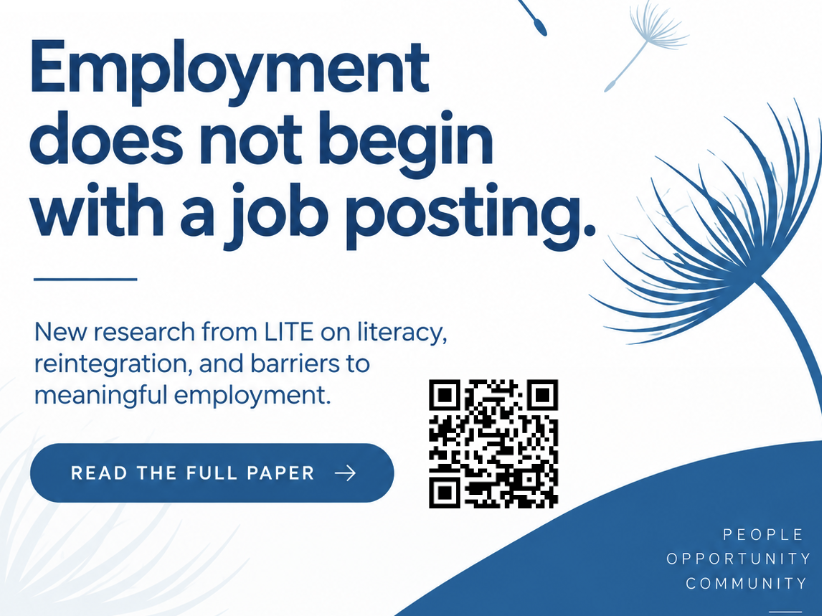
LITE is pleased to share new research examining the relationship between literacy, incarceration, reintegration, and access to meaningful employment.
Developed through research connected with Elizabeth Comack and Jim Silver, this work draws on academic research and the experiences of individuals directly impacted by incarceration. At its core, the research asks us to think more broadly about what meaningful access to employment actually requires.
One of the clearest conclusions of the project is simple: employment does not begin with a job posting.
For many people facing barriers to employment, the pathway begins much earlier. It begins with access to education, literacy, stability, community support, and the ability to navigate the systems and institutions that shape everyday life. A person’s ability to understand information, advocate for themselves, pursue opportunities, and participate fully in community life can all be affected by literacy. When those barriers intersect with poverty, incarceration, limited educational opportunities, and the challenges of reintegration, access to meaningful employment becomes significantly more complex.
Meaningful employment is about more than securing a job. It is connected to dignity, opportunity, stability, and the ability to participate in community and economic life. Strengthening employment pathways therefore requires a broader understanding of the barriers that can shape a person’s ability to reach those opportunities in the first place.
This research contributes to that understanding by examining how literacy, education, reintegration, and systemic barriers can influence a person’s path toward employment. It also reinforces the importance of community based supports, stronger partnerships, and approaches that recognize the realities facing people who have experienced exclusion from education, employment, and other systems.
Rather than allowing the work to remain as a single academic paper, LITE is using the research as part of a broader public conversation about employment, reintegration, and community economic development. The full paper is being shared as a white paper through LITE’s website, with key themes and findings also being developed into shorter blog pieces over time.
This approach allows the research to remain substantive while making it more accessible to community members, partner organizations, practitioners, and the wider public. It also creates opportunities to strengthen relationships with organizations working at the intersection of justice, education, reintegration, and employment.
Ultimately, this research is about understanding what meaningful access to opportunity actually requires. If we want to create stronger employment pathways and stronger communities, we also have to understand the conditions that help people move toward those opportunities.